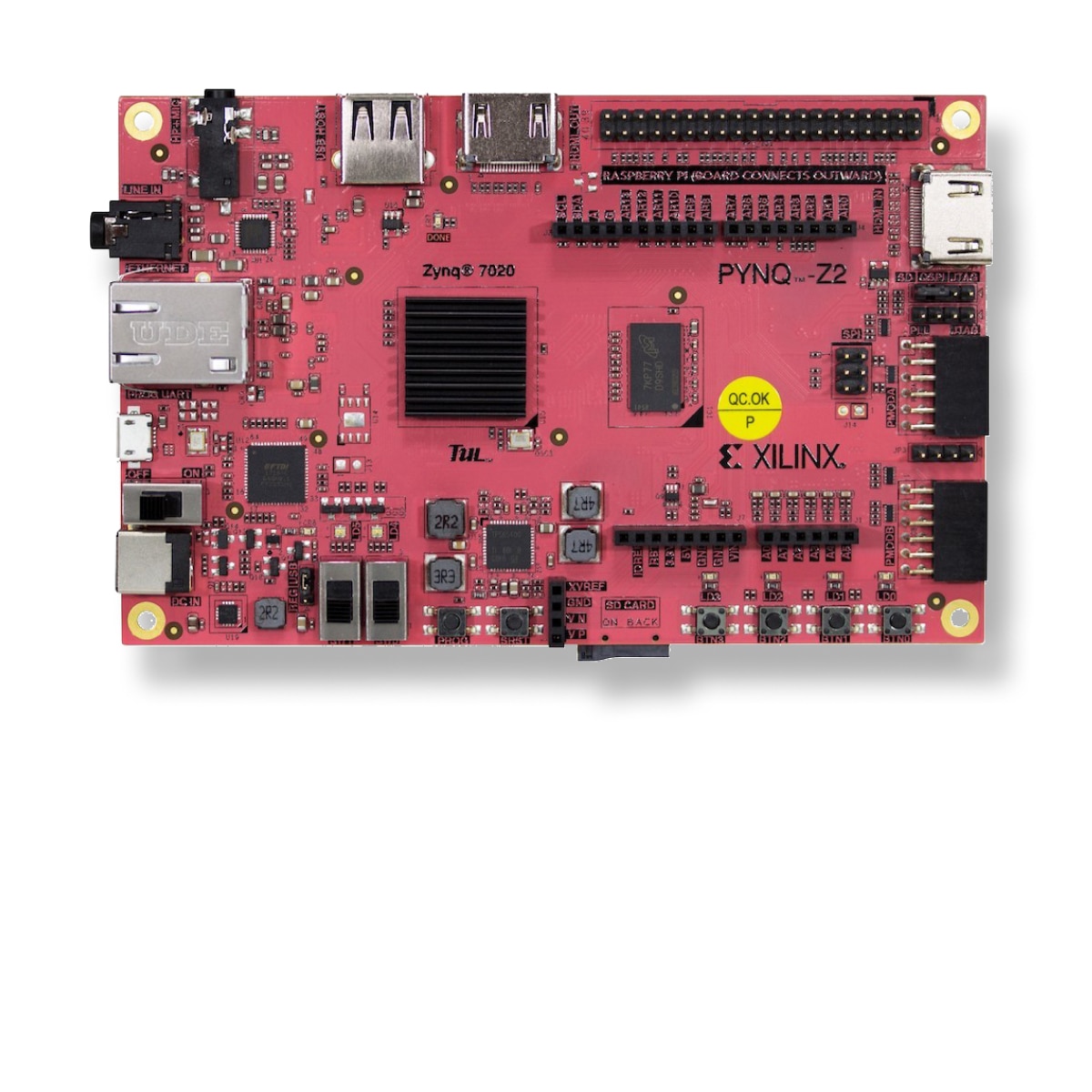

AMD PYNQ-Z2

Best prototyping platform for students and researchers exploring programmable logic.
This board bridges the intimidating gap between high-level software and low-level hardware by letting you program complex logic using Python. It sacrifices the raw, bare-metal control of traditional FPGA development, but gains an accessible, rapid prototyping environment that makes advanced system design feel surprisingly approachable.
$129.00
at
AMD
Who it's for
- Python developers exploring hardware acceleration without complex HDL knowledge
- Engineers needing flexible hybrid software and hardware development platforms
- Makers building projects requiring diverse peripheral and sensor integration
Who should skip it
- Beginners expecting instant results without studying hardware-software co-design
- Advanced developers requiring high-capacity logic resources for complex designs
- Budget-conscious hobbyists seeking inexpensive general-purpose computing boards
Performance breakdown
Python Accessibility
PYNQ framework makes FPGA development approachable for software-focused engineers.
Expansion Versatility
Broad compatibility with Arduino, Pmod, and Raspberry Pi ecosystems.
Processing Power
Dual-core ARM architecture handles embedded tasks with reliable, consistent speed.
Multimedia Connectivity
Integrated HDMI and audio interfaces simplify complex signal processing projects.
Development Tooling
Robust support via Vivado and Vitis streamlines the design workflow.
System Monitoring
Onboard power analysis provides essential feedback for efficient hardware optimization.
Key Specs
FPGA
Zynq-7000 SoC XC7Z020-1CLG400C
Processor
Dual ARM Cortex-A9 MPCore @ 450 MHz, 512 KB L2 Cache, 256 KB On-Chip Memory
Logic Cells
85,000
DSP Slices
220
RAM
512 Mbyte DDR3 @ 1050 Mbps
Onboard Flash
128 Mbit Quad-SPI Flash
Micro SD Card Connector
Supported
I/O Interfaces
USB-JTAG Programming, USB OTG 2.0, USB-UART bridge, 10/100/1G Ethernet, HDMI Input, HDMI Output, I2S interface with 24bit DAC, Line-in
Expansion Ports
2 Pmod ports (16 Total FPGA I/O), 1 Arduino Shield connector (24 Total FPGA I/O), Raspberry Pi connector (28 Total FPGA I/O)
Analog Inputs
6 Single-ended 0-3.3V Analog inputs to XADC
Know before you buy
Still have a question?
Ask Metto anything about the AMD PYNQ-Z2 before you decide.